The role of Leadership in AI adoption
Updated: Jul 7
Leaders have an important role to play in adoption of AI solutions. By virtue of their position, leaders have the power to legitimize and approve change in the organisation and have control over people and resources.³
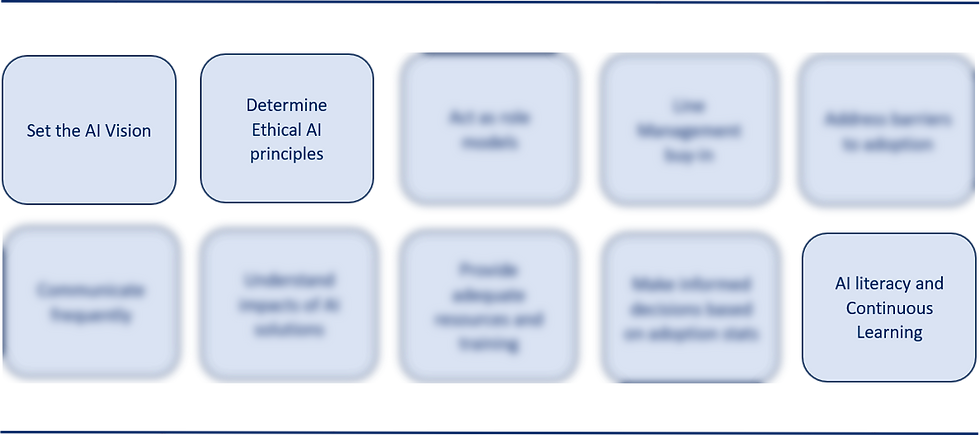
Against this backdrop, leaders should consider implementing the following tactics:
Communicating a clear vision for AI in the organisation and identify objectives, outcomes and measures.¹
Determining ethical principles the organisation will embrace as it pertains to AI.
Embracing AI literacy and continuous learning as this allows for more informed decision-making.¹
Set the AI Vision
Leaders should create and articulate a clear AI vision for the organisation, showing how it links to the organisation’s vision and strategy. This will give employees clarity as to the direction of the organisation with AI integrated into systems, processes and ways of working, thereby allowing them to decide what it means for them and their role. Different emotions will surface e.g. joy, indifference and fear, but at a minimum, it is imperative for awareness and will provide employees information from which they can take control of their career. In addition, visionary leaders who are great storytellers and enthusiastic about how AI will enhance work, are more likely to positively affect adoption of new AI systems.¹
Determine Ethical AI principles
Outlining and utilising ethical principles as it pertains to AI systems that will be used in the organisation and what happens to the data collected, can foster trust and legitimacy from employees and external stakeholders, much like how sustainability is viewed. Setting AI ethical principles and not adhering to them is termed as ‘blue washing’ which has a tendency to erode trust.² Once the ethical principles are established, they could be communicated separately or with the AI vision.
This tactic is non-negotiable and should be embraced with vigour. An overview of the AI landscape, regulations, the importance of ethics in AI, solutions designed for the industry along with benefits and outcomes, is just the starting point for leaders to be able to make better and more informed decisions and communicate more effectively, instead of telling employees 'just use it'. The result would be AI solutions that are responsible, ethical and fit for purpose and communications that are thoughtful, thus increasing the likelihood of adoption.
These are three (3) of ten (10) attributes that can aid AI adoption from a leadership perspective, the full list and implementation strategy is available through our enterprise strategy consulting workshops.
References
[1] Amir Michael et al, 'Beyond the Hype: How AI will change your leadership journey' (Panel discussion at Durham University Business School, Durham, 30 June 2026)
[2] Nikita Mishra (2023) Ethics or charade? The troubling truth of bluewashing, Campaign Asia, 25 May. Available at: https://www.campaignasia.com/article/ethics-or-charade-the-troubling-truth-of-bluewashing/484603(opens in a new tab) (Accessed: 1 July 2026).
[3] Richard Smith et al (2015) The Effective Change Manager’s Handbook, Kogan Page